World's largest metamorphic rock oilfield central platform completes float-over installation
It is reported that with the upper topsides weighing over 16,000 tons precisely positioned onto the jacket, the central platform of the Bozhong 26-6 oilfield, the world's largest metamorphic rock oilfield, has completed its float-over installation in the southern waters of the Bohai Sea, marking significant progress in the project construction.
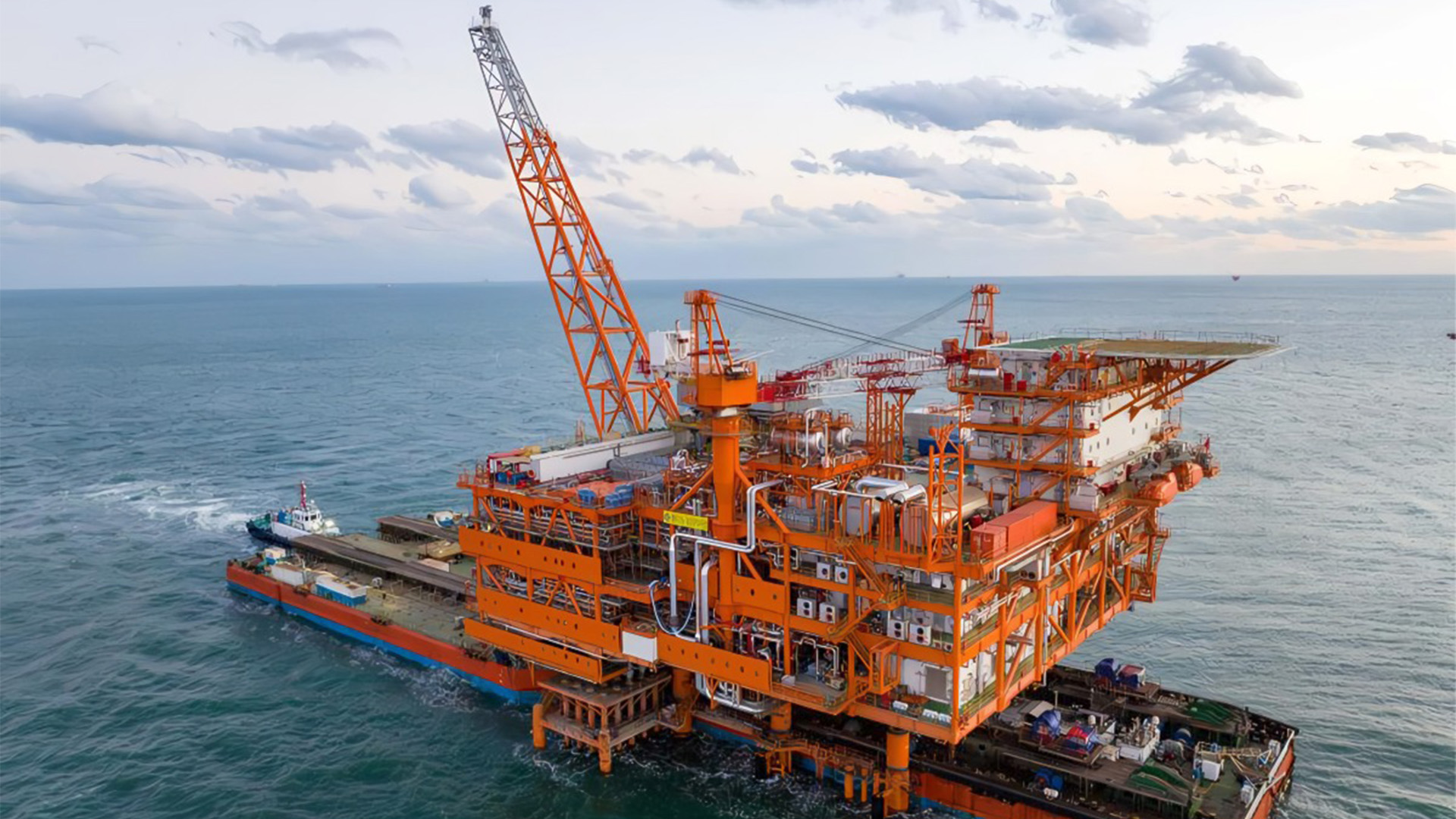
The Phase I development project of the Bozhong 26-6 oilfield mainly includes the construction of one central processing platform and one unmanned wellhead platform. The central platform installed this time is a 3-deck, 8-leg multifunctional integrated offshore oil and gas platform integrating production and living quarters, measuring 86.3 meters in length, 69.1 meters in width, and 22.8 meters in height, comprising over 160 sets of production equipment and a living quarters capable of accommodating 60 people.
The float-over design weight of the platform topsides is approximately 16,326 tons, exceeding the capacity limits of domestic floating cranes, thus the float-over method was adopted for offshore installation.
The winter weather in the Bohai Bay is changeable with severe sea conditions. The construction area is located in a platform-dense zone with submarine pipelines as intricate as a "spider web." Operators need to rely on tidal forces on the rough sea surface, through barge ballasting, to achieve precise alignment between the mega-ton topsides and the jacket, with the alignment accuracy reaching millimeter level.
It is understood that the project team carried out upgrade and renovation on the main installation vessel in advance, applied digital tools to precisely formulate the float-over plan, conducted simulation drills, and strengthened monitoring of vessel transportation status and tidal dynamics. During the float-over operation, the project achieved one-time precise float-over positioning of the topsides through measures such as multi-tug coordinated vessel control.
The Bozhong 26-6 oilfield is located in the southern waters of the Bohai Sea, approximately 170 kilometers from Tianjin, with an average water depth of about 22 meters. Its reservoir is buried in buried hills thousands of meters below the seabed, mainly composed of metamorphic rock. In 2024, newly added proven oil and gas geological reserves exceeded 40 million cubic meters, and the cumulative proven geological reserves of the oilfield exceeded 200 million cubic meters, making it the world's largest metamorphic rock oilfield.